Context
Beli is an app that allows users to share food recommendations with friends, personalizing the food experience and building a community among foodies. As someone who loves venturing new foods, I wanted to reduce decision fatigue when deciding a place to eat. This idea was a part of an independent case study in my Digital Product Design class at Cornell.
Problem + Research
How does Beli help people decide a place to eat?
After interviewing four individuals, I was able to get a better idea as to how Beli is used and how food discovery currently looks like.
- “After receiving a notification from my friend, I opened the app to browse and rank the restaurant we went to together.”
- “When I want to eat with my friends, I use beli and surf the app through the feed to look for recommendations.”
- “Beli encourages me to try new places to eat through the school leaderboard and ranking system.”
Insights from the interview:
- Friend’s activity boosts others’ engagement
- Promotes food exploration in metropolitan areas through competition
- Trusteed reviews help decide where to eat.
Revisiting the People Problem
When I am deciding on a place to eat, I want to choose a restaurant based on personalized recommendations, so I can confidently choose a place that I will enjoy. But this is hard because:
-
Hard to connect personalized recommendation system with friend’s activity to make a decision
-
Existing solutions has a place for multiple user input without a specific direction in where to take them
Market research
How do existing products provide recommendations?
Yelp provides anonymous reviews with details for ratings and specific notes from random users. Google Maps provides recommendations mostly from where the user is located and they’d have to search it up. Both of these experiences are isolated, focusing on getting reviews or navigating to the place.
Spotify blend provide recommendations through themed-playlists or shared playlists with friends. Many of the recommended songs are based on the user’s current listening experience. Friends’ activity is also used to build the shared playlists.



Brainstorming
How do we maintain and prioritize trust while streamlining the process of transforming personalized recommendation to meaningful decisions?
From the research, I centered my solutions around answering this question. I identified three opportunity areas to brainstorm more specific solutions, coming up with two specific solutions in each of the spaces - six solutions total.
-
1. Friend’s Data
- Remix of friends and users’ activity user to create a list of recommendations
- Food Blend similar to Spotify Blend
-
2. Decision Making
- Q&A to break down the decision-making process
- User Tags to categorize user’s eating activity to choose similar places
-
3. Navigation & Recommendations
- Messaging System for receiving recommendations
- Additional Filters to current recommendation system
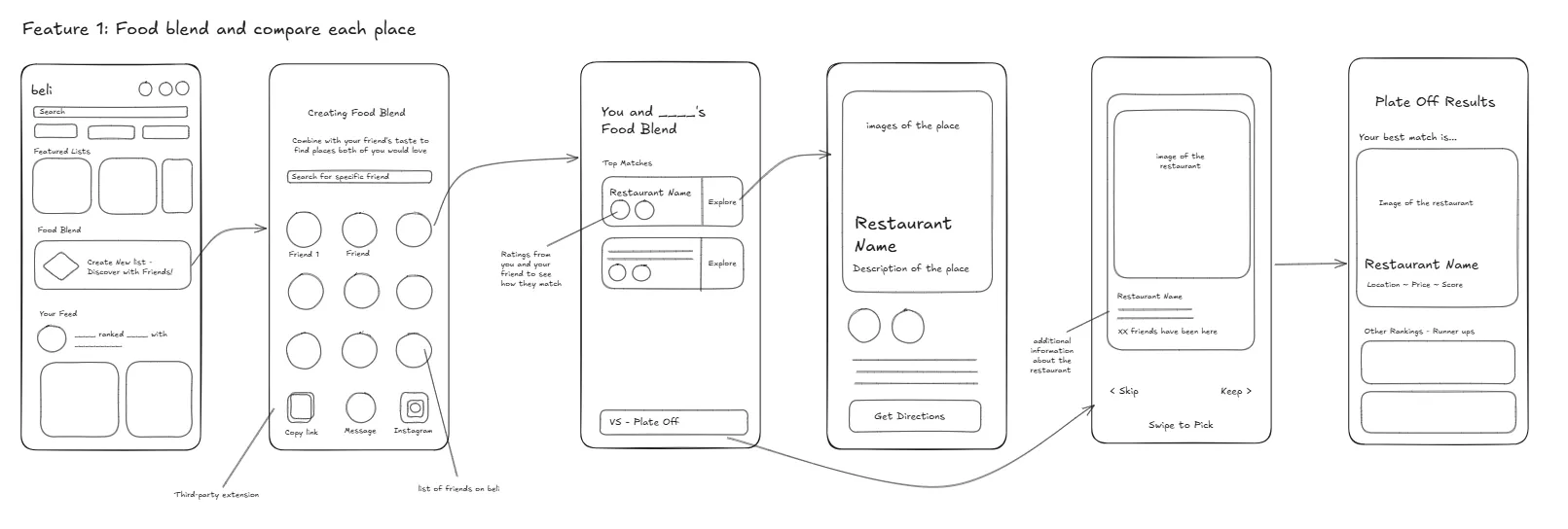
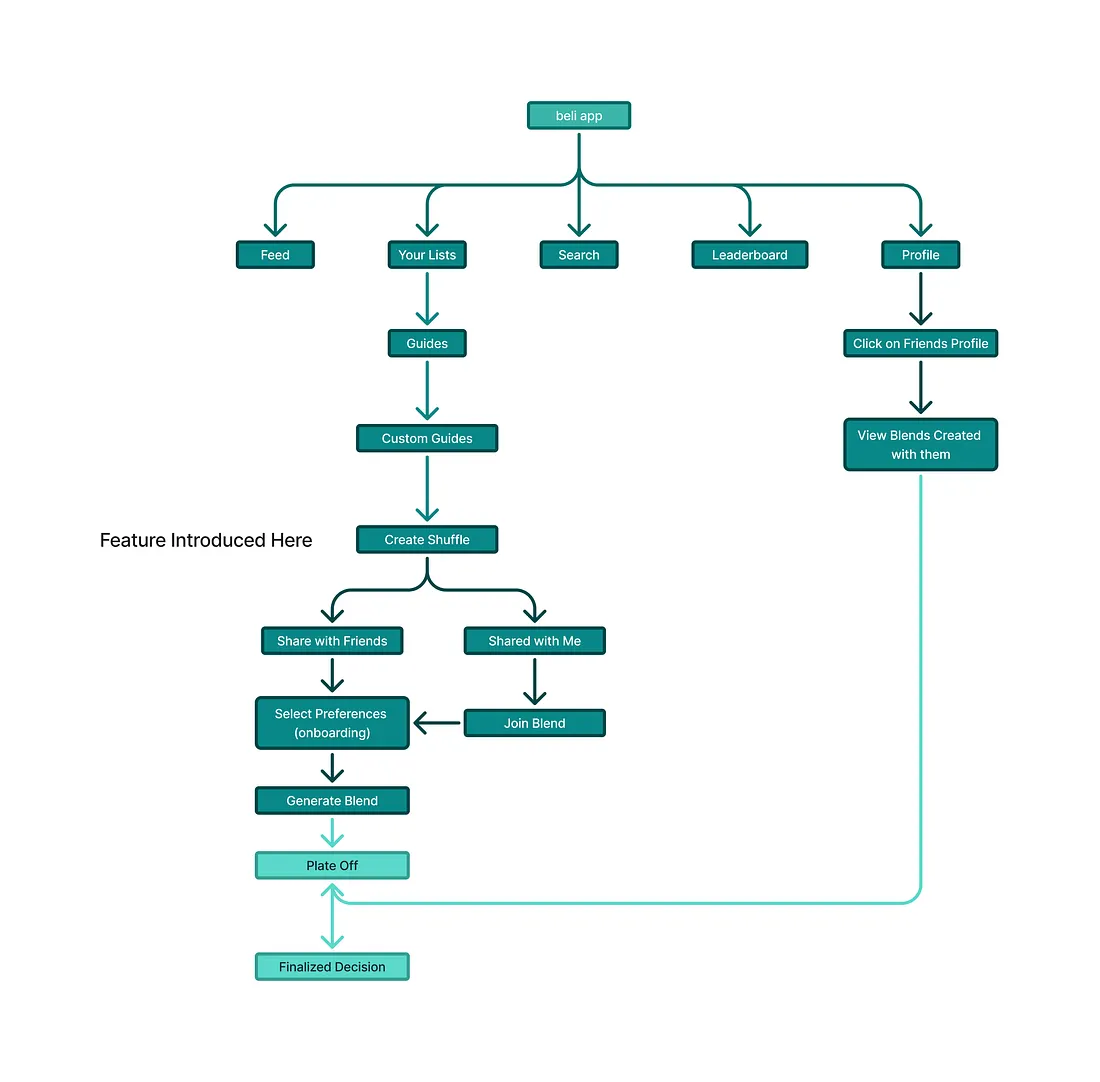
After completed SWOT and feasibility& impact analysis of each solution, I decided to focus on the Food Blend and Plate Off feature where users can compare recommendations to come to a decision. Food Blend invites the user’s friends to generate a list and Plate Off allows users to compare each of the restaurants by swiping to generate a ranked list.
Visualizing the solution...
Iterating
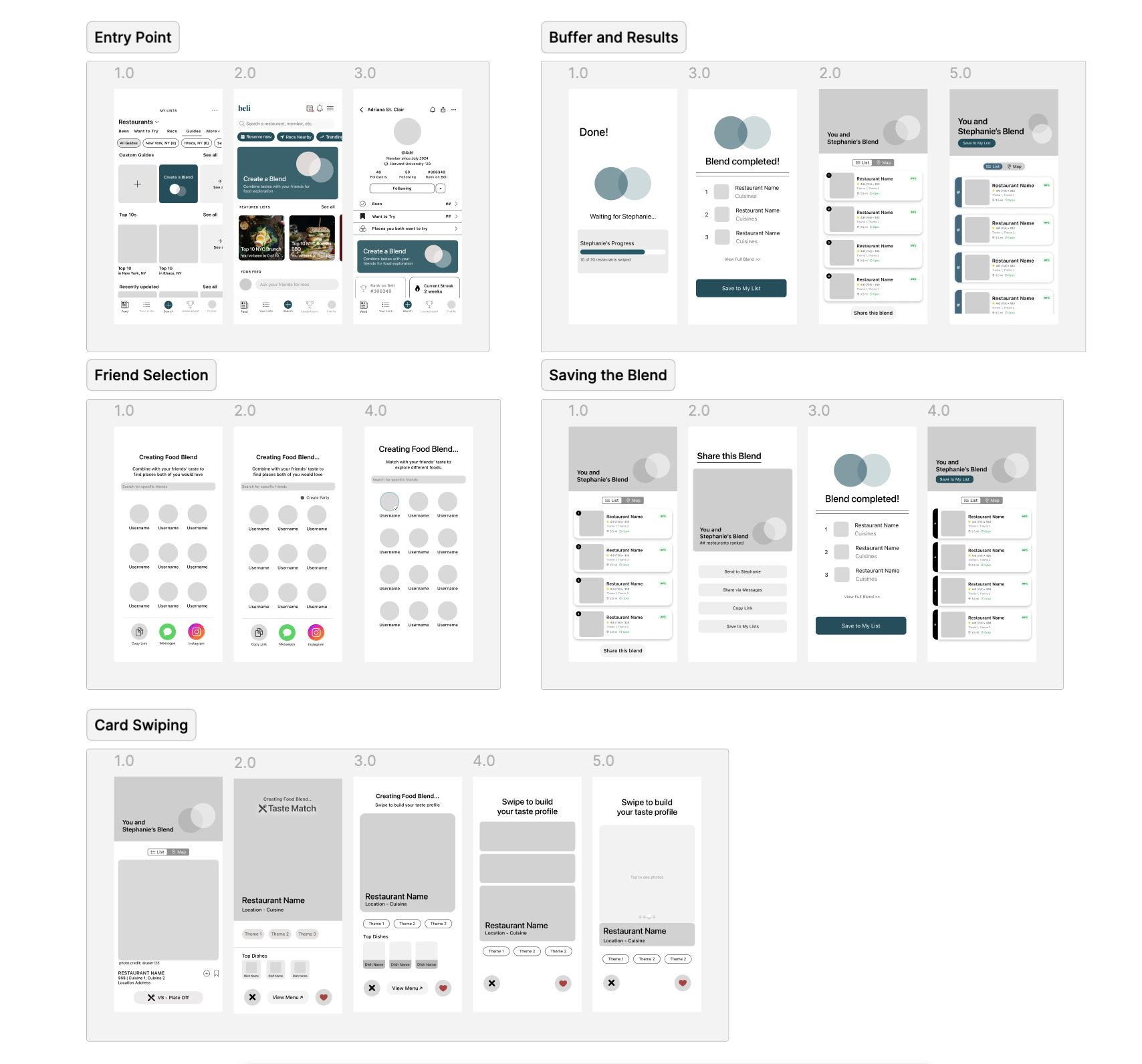
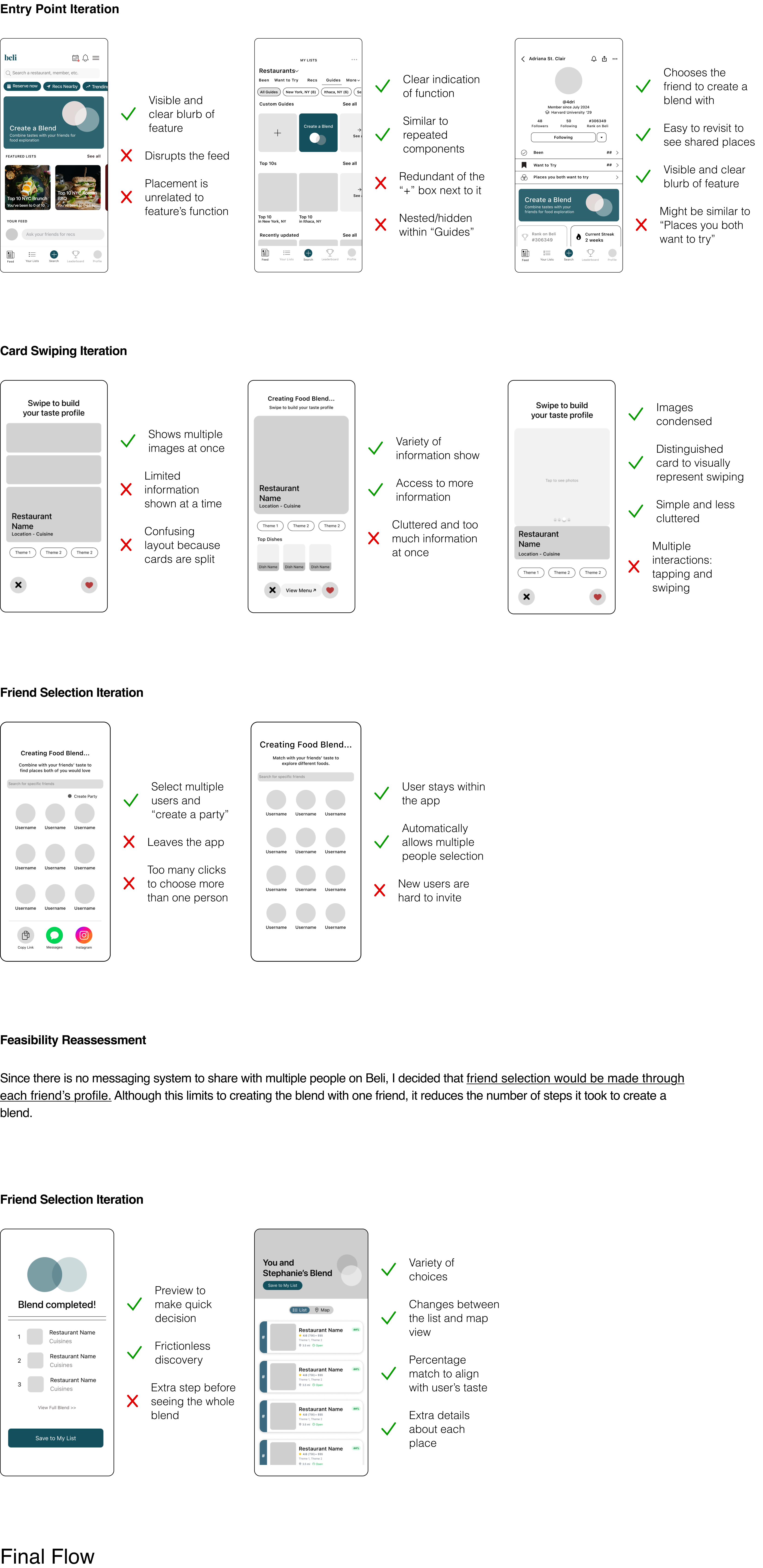
Exploration and design decisions
Final Flow
User testing
Testing our solution.
After user feedback, we revisited and made changes to our designs.
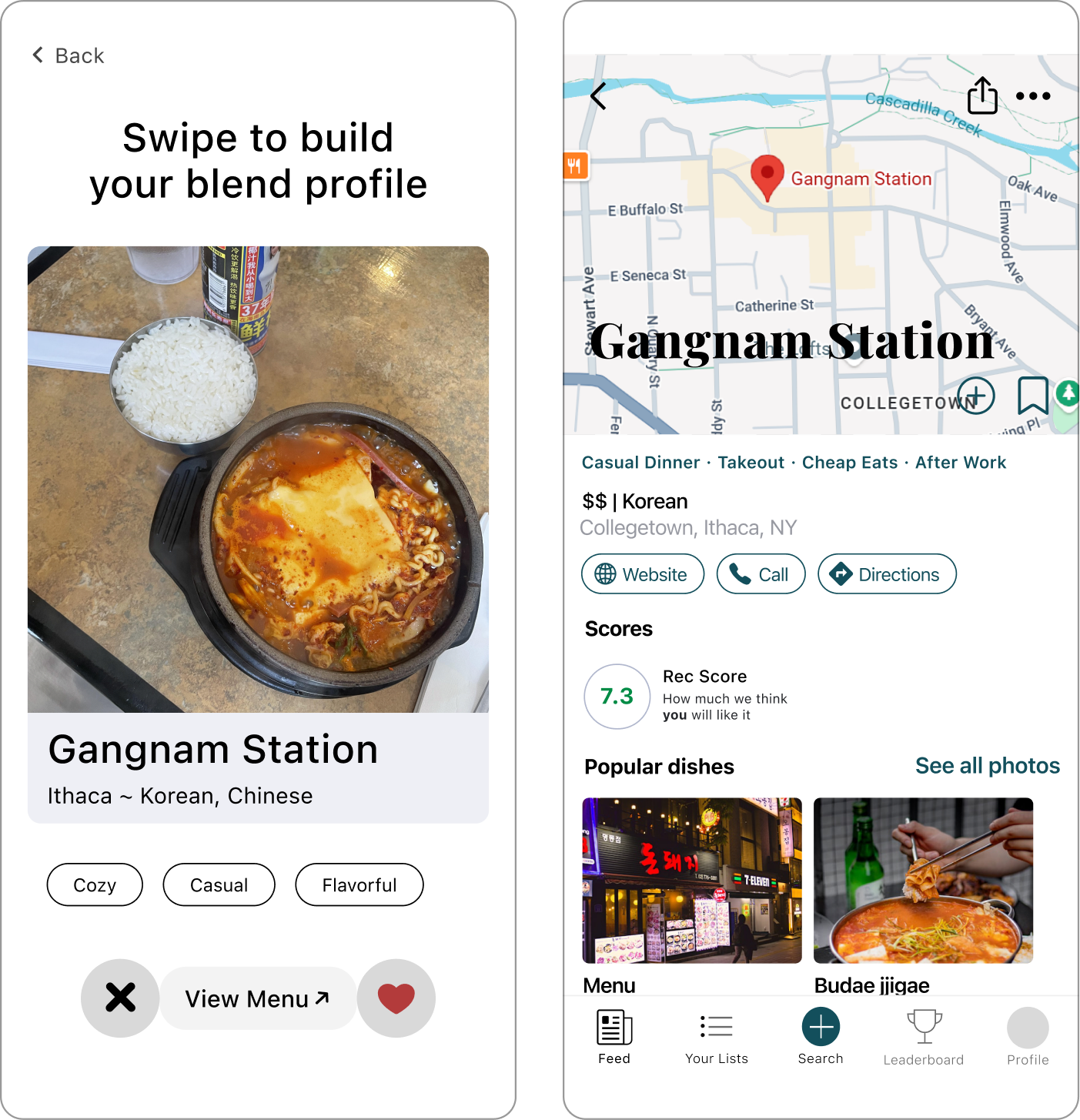
- Multiple stacked pictures replaced with separate screen to show more details
- Distinguished actions for more information and inputting preferences
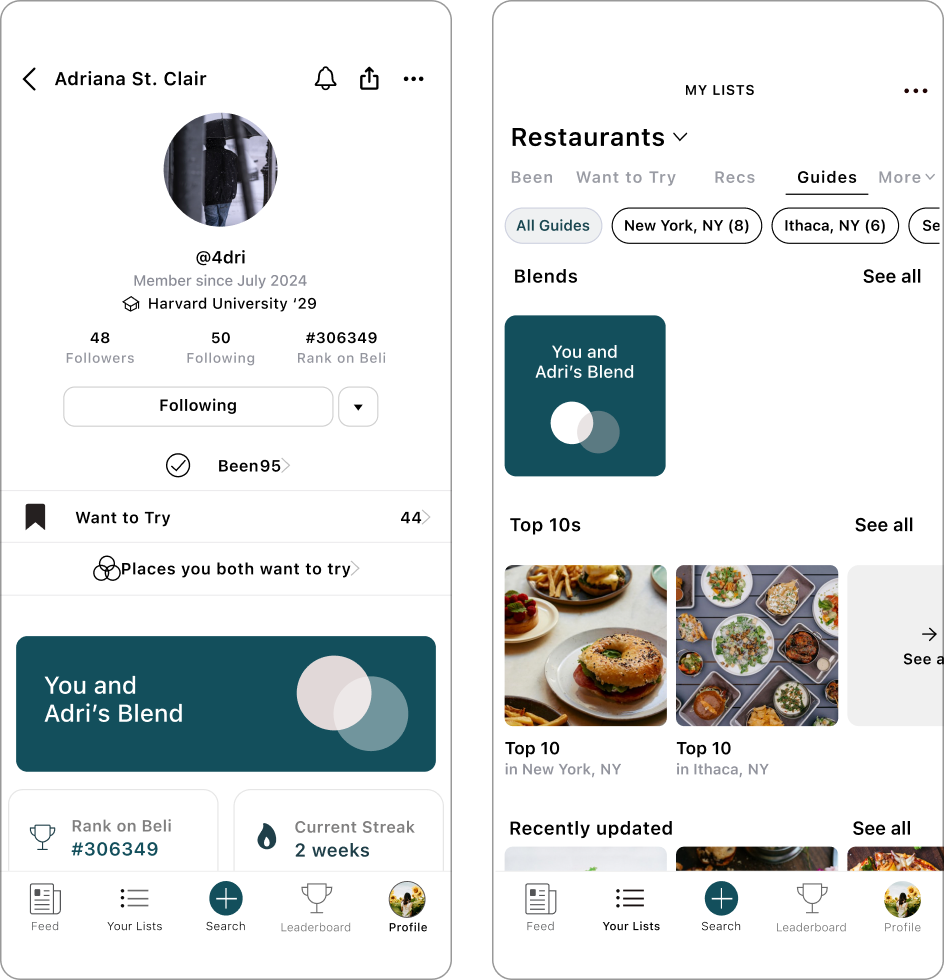
- Blend available through friend’s profile and separate section in guides
- Feature is accessible in social aspect
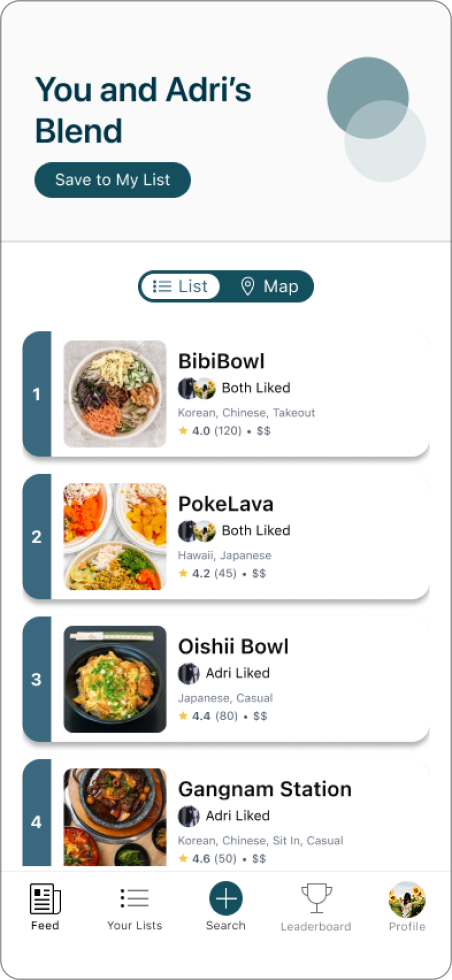
- Percent number over condense opinions / could be ambiguous
- User profiles to represent preferences
The Final Product
Reflection
If I had more time...
- Group Settings Adding themes to blends or categorizes to further encourage food exploration
- Messaging Adding themes to blends or categorizes to further encourage food exploration
- Gamifying the Experience Adding themes to blends or categorizes to further encourage food exploration
What I learned.
-
Continue Iterating!
There were moments where I was stuck when designing, but creating more iterations led to new directions of the project.
-
Adapt to Changes
When iterating and designing my solution, Beli developed new features that pushed me to reassess my people problem. Although the design process can sometimes be unpredictable, it has pushed me to be more creative.
-
User Empathy
It was important for me to recognize that the problem I identified early on did not encompass the full user experience. By revisiting my people problem, I am able to brainstorm solutions that center the user.